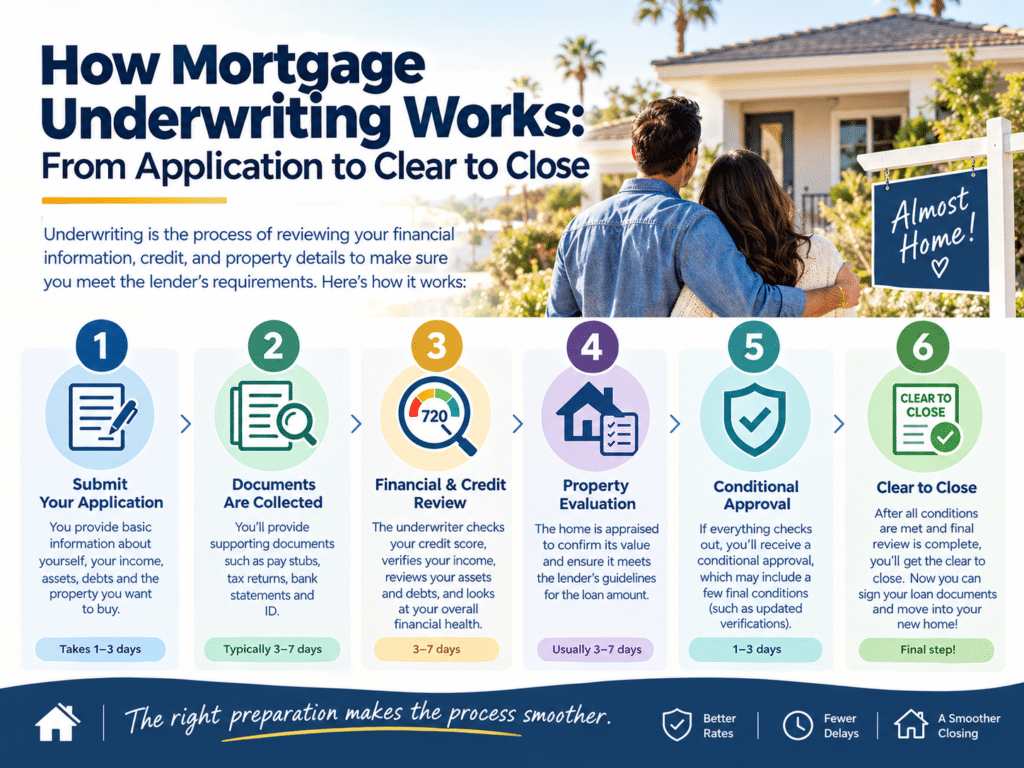
Underwriting is the part of a mortgage that borrowers experience as a black box. You send documents in, silence follows, and then a list of requests comes back that seems to ask for things you already sent.
It is not arbitrary. An underwriter is answering a specific set of questions in a specific order, and almost everything that looks like a strange request is one of those questions not yet fully answered. Once you can see the questions, the process becomes predictable and, more usefully, faster.
This article walks through what underwriting evaluates, the stages a file moves through, how to clear conditions quickly, and what can still change the outcome after an approval.
What underwriting is actually deciding
Lenders commonly organize the review around four questions. The industry shorthand is the four Cs.
| Area | The question behind it | What tends to answer it |
|---|---|---|
| Capacity | Can you support the obligation from income, alongside your other debts? | Income documentation, employment verification, debt statements |
| Capital | Do you have the funds to close, plus reserves afterward? | Bank and asset statements, sourcing of deposits, gift documentation |
| Credit | What does your history of repaying obligations show? | Credit report, explanations for any events, housing payment history |
| Collateral | Does the property support the loan? | Appraisal, property condition, title, insurance |
A fifth item, sometimes called conditions, covers the loan purpose, the program, and the circumstances of the transaction. Different programs weight these differently. A DSCR investment property loan leans heavily on the property’s cash flow. A VA-backed loan brings entitlement and program rules into the picture. The four questions themselves stay recognizable across programs.
The stages, in order
1. Application
You provide information about yourself, the property, and the loan you want, and you authorize a credit check. This is where accuracy pays off. An application that understates a debt or omits a property does not make the file easier; it makes it slower, because the discrepancy surfaces later.
2. Disclosures
You receive and acknowledge required disclosures, including a Loan Estimate showing estimated costs. Read the Loan Estimate. It is the document designed to let you compare offers, and it exists specifically so you do not have to take a verbal quote on trust.
3. Processing
Your file is assembled. Documents are collected and organized, verifications are ordered, and gaps are identified before an underwriter sees it. A good processor catches missing pages at this stage rather than after underwriting has already reviewed the file.
4. Appraisal and title
The lender orders a property valuation and title work. These run in parallel with the file review. Title work confirms ownership and reveals liens, judgments, or recording problems. Both can produce items that need resolving.
5. Underwriting review
An underwriter reviews the file against the applicable guidelines. Depending on the program, an automated underwriting system may generate an initial recommendation, with a person reviewing the file and the documentation behind it. Some files are underwritten manually, which is common when the situation does not fit a standard pattern.
6. Conditional approval
The usual output is an approval that lists outstanding items. These are called conditions. Receiving conditions is normal and is not a sign the file is in trouble.
7. Clearing conditions
You and your loan officer supply what is asked. The underwriter reviews and either clears the item or asks a follow-up. This is the stage where a borrower has the most influence over the timeline.
8. Clear to close
Conditions are satisfied and closing documents can be drawn. You receive a Closing Disclosure before signing. Compare it against your Loan Estimate and raise any questions before you sign, not after.
9. Signing and funding
You sign, the loan funds, and the transaction records. Some transactions include a rescission period, depending on the loan type.
Why underwriters ask what they ask
Most requests that feel redundant are one of these.
| The request | What it is really asking |
|---|---|
| All pages of a statement, including blank ones | Confirmation that nothing was omitted, and that the document is complete and unaltered |
| Explain this deposit | Whether funds came from an acceptable source rather than undisclosed borrowed money |
| Updated pay documentation | Whether the income used to qualify is still current at closing |
| A letter of explanation | Context that turns an unexplained item into a documented one |
| Verification of employment near closing | Whether your employment status has changed since the file was reviewed |
| Documentation on a debt you already disclosed | The exact payment, balance, and terms, which the credit report may not show completely |
| Evidence of insurance | That the collateral is covered from the day the loan funds |
| Entity documents | Who has authority to borrow and to sign, when title is held by an LLC or trust |
How to clear conditions quickly
- Send complete documents. Every page, unedited, in a readable format. Partial uploads restart the cycle.
- Answer the question that was asked. If the request is a source for a deposit, send the source, not another copy of the same statement.
- Send everything at once. Files reviewed in one pass move faster than files reviewed five times.
- Write explanations plainly. A short, factual letter of explanation with dates is worth more than a long one.
- Flag changes immediately. A new job, a new account, a large purchase, a gift. Tell your loan officer before it happens where you can.
- Ask what the condition is for. Knowing which of the four questions is still open usually makes the right document obvious.
What can still change the outcome after approval?
An approval reflects a file at a moment in time. These are the things that most often change it:
- New credit. Opening an account, financing a purchase, or co-signing changes the debt picture.
- Employment changes. A new job, a change from salaried to self-employed, or a gap can require re-verification.
- Large or unsourced deposits. Money that arrives without documentation creates a question that has to be answered.
- Appraisal results. A value below the contract price, or required repairs, can change the structure of the deal.
- Title findings. Liens, judgments, or recording issues have to be resolved before closing.
- Insurance problems. An uninsurable property, or coverage that cannot be bound in time, stops a closing.
- Property condition. Damage between contract and closing can require reinspection.
None of these are exotic. All of them are avoidable or manageable when raised early, which is why the single best habit during underwriting is telling your loan officer about changes as they happen.
How underwriting differs by program
| Program | Whose guidelines apply | Where the emphasis sits |
|---|---|---|
| Conventional | Fannie Mae and Freddie Mac guidelines, plus lender overlays | Standardized review across all four areas |
| FHA | HUD guidelines, plus lender overlays | Program rules and property standards carry real weight |
| VA | VA program rules, plus the lender’s own credit standards | Entitlement, occupancy, and the VA appraisal |
| DSCR | Non-agency, set lender by lender | The property’s cash flow relative to its obligations |
| Bridge | Non-agency, set lender by lender | Collateral and the credibility of the payoff plan |
| Construction | Varies by structure and lender | The budget, the scope, the builder, and the draw plan |
Two things follow from this table. A decline from one lender does not settle the question, particularly on non-agency products where guidelines differ. And an approval from one lender does not mean another will reach the same conclusion.
Common mistakes
- Treating a pre-approval as final. It reflects a review at a point in time and is not a guarantee of funding.
- Making financial moves mid-process. New credit, big purchases, and moving money between accounts all create work.
- Sending partial documents. The most common cause of avoidable delay.
- Going quiet. Conditions sit until answered. Silence is the slowest possible response.
- Hiding a problem. Underwriters find things. A disclosed and explained issue is far easier to work with than one discovered late.
- Skipping the Loan Estimate comparison. It exists so you can compare offers on the same basis.
- Assuming every lender is identical. Overlays and non-agency guidelines differ meaningfully.
- Forgetting the property is also being underwritten. Appraisal, title, and insurance can change the outcome regardless of how strong your file is.
Frequently asked questions
What does a mortgage underwriter actually do?
An underwriter reviews your file against the applicable program guidelines and decides whether the loan can be approved, and on what conditions. The review covers your capacity to support the obligation, your funds, your credit history, and the property itself.
How long does underwriting take?
It varies by lender, program, and how complete the file is, so ask your loan officer for their current expectation and what would change it. The factor most within your control is how quickly and completely you respond to conditions.
What is a conditional approval?
An approval issued with a list of outstanding items that still need to be provided or resolved. It is a normal outcome, not a warning sign.
What does clear to close mean?
Conditions have been satisfied and closing documents can be drawn. You will receive a Closing Disclosure before signing, and you should compare it with your Loan Estimate.
Why does the underwriter want a letter of explanation?
Because a file has to document why something happened, not just that it happened. A short factual letter with dates converts an open question into a documented one.
Can a loan be denied after a pre-approval?
Yes. A pre-approval reflects a review at a point in time. Final approval depends on full underwriting, the appraisal, title, insurance, and your circumstances at closing. All financing is subject to underwriting approval.
Does the property get underwritten too?
Yes. The appraisal, property condition, title, and insurability are all part of the decision. A strong borrower file does not override a problem with the collateral.
What is an automated underwriting system?
It is software that evaluates a file against program guidelines and returns a recommendation. Depending on the program, it may be part of the process alongside a person’s review of the file and the supporting documentation. Some files are underwritten manually instead.
Should I stop using credit during underwriting?
Avoid opening new accounts, financing purchases, and making large unexplained transfers where you can, since each creates new questions. If something is unavoidable, tell your loan officer in advance so it can be documented rather than discovered.
Underwriting is a structured set of questions about your capacity, your funds, your credit, and the property. The file moves from application through processing, appraisal and title, underwriting, conditions, and clear to close. Conditions are normal. Complete documents and fast, accurate responses are the biggest lever you control. And keep your financial picture still until the loan funds, because an approval reflects a file as it stood on the day it was reviewed.
If you want to know how your specific situation would be reviewed, Sprint Funding can walk through it with you. Find a mortgage advisor or contact the office for a written quote.
About this article
Sprint Funding, Inc. publishes this article and offers the loan products described in it. Treat it as educational content from a company with a commercial interest, not as independent advice. Nothing here is a loan offer, a commitment to lend, or legal, tax, or financial advice. Loan options vary by borrower qualifications, and all financing is subject to underwriting approval. No rates, payments, or loan terms are quoted here. Ask a licensed loan professional for a written quote, and review your Loan Estimate, your Closing Disclosure, and your note before you commit.
This article describes a general industry process. Underwriting guidelines, documentation requirements, and timelines vary by lender, program, investor, and borrower profile, and they change. Nothing here is a statement of Sprint Funding’s guidelines or a prediction about any specific file. Reviewed August 4, 2026.
Sprint Funding, Inc., NMLS ID 348300. State licensing is listed at sprintfunding.com/state-licenses. Sprint Funding is a private company and is not a government agency.