Blog

Why San Diego’s Housing Market Makes Mortgage Pre-Approval Essential Before You Shop
Shopping for a home without a pre-approval is shopping without knowing your budget. In a market where prices commonly push against and past the conforming loan limit, that is an expensive way to learn what you can borrow. There is a second reason, and it has nothing to do with
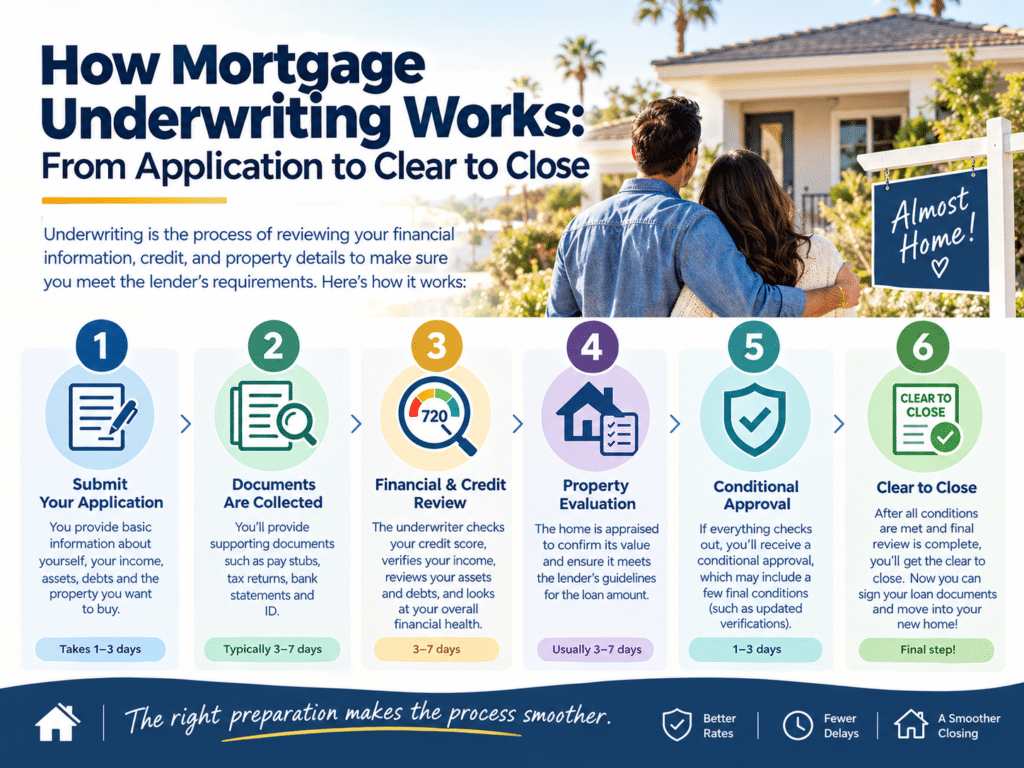
How Mortgage Underwriting Works: From Application to Clear to Close
Underwriting is the part of a mortgage that borrowers experience as a black box. You send documents in, silence follows, and then a list of requests comes back that seems to ask for things you already sent. It is not arbitrary. An underwriter is answering a specific set of questions
FHA Loan Limits in San Diego County: What Changed for 2026
FHA loan limits reset every year, and 2026 is no exception. The Federal Housing Administration published its new limits in Mortgagee Letter 2025-23 on December 11, 2025, and they apply to FHA case numbers assigned on or after January 1, 2026. The part most buyers get wrong is not the
California Conventional Loan Limits 2026: What San Diego Buyers Need to Know
The Federal Housing Finance Agency sets a new conforming loan limit every year, and the number that applies to a San Diego County purchase is different from the national figure and different again from the figure in Los Angeles. For 2026, the conforming loan limit in San Diego County is $1,104,000 for

Discounted vs. Undiscounted Cash Flow: Key Differences Explained
A fundamental concept in investments is the time value of money—the idea that there is a greater benefit to receiving a sum of money now rather than an identical sum later. It also takes into account the reduction in the real value of funds from the effects of inflation. There
DSCR Loans for Short-Term Rental Investors in California’s Coastal Markets
A DSCR loan is underwritten primarily on the property’s cash flow rather than on the borrower’s personal income documentation. That makes it a common tool for investors buying rental property, including short-term rentals along the California coast. Coastal short-term rentals add a second layer that inland rentals do not have.
VA Loans for Veterans in San Diego: Using Your Benefits Near Naval Base San Diego and Camp Pendleton
San Diego County holds one of the largest concentrations of military and veteran households in the country. Naval Base San Diego anchors the southern end of the county, Marine Corps Base Camp Pendleton sits at the northern end, and Naval Base Coronado, Naval Base Point Loma, and Marine Corps Recruit

Pros and Cons of DSCR Loans for First-Time Real Estate Investors
DSCR loans (Debt Service Coverage Ratio) allow first-time investors to qualify based on property rental income rather than personal income, enabling faster closings and financing for multiple properties. However, they feature higher interest rates, larger down payments (20-25%+), and prepayment penalties, making them better suited for properties with strong, verified

Private Mortgage Insurance (PMI): When It’s Required and How to Remove It
Private Mortgage Insurance (PMI) is typically required on conventional loans when a down payment is less than 20% (over 80% Loan-to-Value or LTV). It protects lenders if borrowers default. PMI can be removed by submitting a request once equity hits 20% (80% LTV) and automatically terminates at 78% LTV, or

Common Reverse Mortgage Misconceptions Homeowners Should Know
Reverse mortgages allow seniors to convert home equity into cash without monthly repayments, but misconceptions often cause hesitation. Key truths are that you retain home ownership, heirs can inherit the home (by repaying the loan), and you cannot be forced out if you pay taxes/insurance and live there. A reverse
- Blog
- Bridge Loan
- Buying
- Cash Flow Loans
- Construction Loans
- Conventional Loans
- Credit
- DSCR Loans
- DSCR Loans
- Economy
- FHA Loans
- Home Loan
- Home Values
- Interest Rates
- Loan
- Loan Programs
- Mortgages
- Renovation Loans
- Rental Properties
- Reverse Mortgage
- Selling
- Uncategorized
- VA Loan
- VA Loan
- Weekly Mortgage Update
 Pros and Cons of DSCR Loans for First-Time Real Estate InvestorsApril 28, 2026
 How Long Can You Hold a Bridge Loan Before Refinancing?March 13, 2026
 How Hard Money Loans Differ from Traditional FinancingNovember 19, 2025
 Weighing the Pros and Cons of Interest-Only MortgagesOctober 28, 2025
 Fixed-Rate vs. Adjustable-Rate Mortgages: Which Fits Your Goals?September 26, 2025