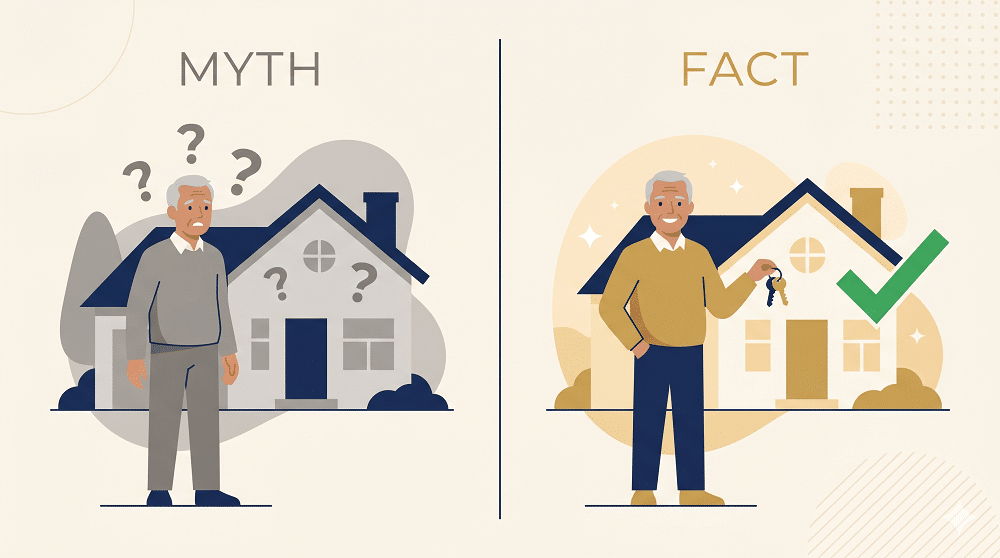
Reverse mortgages allow seniors to convert home equity into cash without monthly repayments, but misconceptions often cause hesitation. Key truths are that you retain home ownership, heirs can inherit the home (by repaying the loan), and you cannot be forced out if you pay taxes/insurance and live there.
A reverse mortgage is one of the most misunderstood retirement-planning tools available to American homeowners. Many seniors hear stories from neighbors, social media posts, or outdated articles and walk away convinced the bank will take their house, that their kids will inherit debt, or that signing the paperwork means losing ownership.
The reality is far different from the rumors, and the gap between belief and fact often keeps homeowners from tapping equity they could use right now to fund a more comfortable retirement.
At Sprint Funding, we are a mortgage company built specifically to help older homeowners understand their options before making big financial decisions. Our team of licensed reverse mortgage specialists focuses on clear, plain-language guidance so families can separate fact from rumor and choose what actually fits their retirement.
Contact us today to talk through your options with a specialist who will put your goals first.
Do You Lose Ownership of Your Home With a Reverse Mortgage?
No. You keep full legal ownership of your home with a reverse mortgage. The borrower stays on the title, exactly like a traditional mortgage. The lender places a lien on the property, but title remains with the homeowner for as long as the home is their primary residence and the loan terms are met.
This myth is one of the oldest and most damaging in the industry. The confusion comes from the loan’s inverted payment structure, which leads people to assume the bank takes possession in exchange for monthly payouts. The Home Equity Conversion Mortgage (HECM), which is the most widely used reverse mortgage, legally requires the borrower to remain on title for the life of the loan.
What Responsibilities Stay With the Homeowner
Holding title comes with the same duties any owner has. HECM borrowers must:
 Pay property taxes on time
- Maintain homeowners insurance coverage
- Keep the property in reasonable repair
- Continue paying homeowners association (HOA) fees if applicable
- Occupy the home as a primary residence
Failing to meet these obligations can trigger a default. The lender does not take the home because they want it. Default only occurs when the borrower stops upholding the basic responsibilities tied to keeping the property. The federal program, regulated by the U.S. Department of Housing and Urban Development (HUD), was built to protect senior homeowners from losing ownership, not to take it.
Will Your Heirs Inherit the Reverse Mortgage Debt?
No. Heirs never personally inherit reverse mortgage debt. The HECM is a non-recourse loan, which means the borrower or their estate will never owe more than the home is worth at repayment. If the loan balance exceeds the property value, FHA mortgage insurance covers the shortfall and shields the heirs completely.
This protection is one of the most important features of the federally insured program. It is funded by the Initial Mortgage Insurance Premium (IMIP) every borrower pays at closing, charged at 2% of the lesser of the appraised value or the HECM lending limit. The maximum IMIP for 2026 is $24,982.50, and that money flows directly into the FHA Mutual Mortgage Insurance Fund (MMIF).
What Heirs Typically Decide
When a borrower passes away or permanently leaves the home, heirs generally have three options:
- Sell the home and use the proceeds to pay off the reverse mortgage. Any equity left over belongs to the heirs.
- Keep the home by paying off the loan balance or 95% of the appraised value, whichever is less.
- Walk away by signing a deed-in-lieu of foreclosure to the lender if the home is worth less than the loan balance, with no personal liability for the shortfall.
Heirs typically have six months to decide, with the option to request two 90-day extensions if they need more time to complete a sale or refinance. The lender cannot force a rushed decision outside the standard HUD notification process.
Are Reverse Mortgage Funds Considered Taxable Income?
No. Reverse mortgage proceeds are not taxable income. The Internal Revenue Service (IRS) treats the funds as loan proceeds rather than earnings, which means they do not affect your federal income tax bracket and are not reported on a 1040. This holds true whether you receive the funds as a lump sum, monthly payments, or a line of credit.
The rule has real advantages for retirees who want to supplement cash flow without triggering a higher tax bracket. Drawing down 401(k) or traditional IRA funds, by contrast, generates taxable income and can raise Medicare premiums and increase the portion of Social Security benefits subject to tax.
What About Public Benefits?
 Reverse mortgage funds generally do not affect Social Security or Medicare eligibility, since both are tied to earned income or work history. Need-based programs such as Medicaid and Supplemental Security Income (SSI) can be affected if the funds are not spent within the same month received and remain in a bank account as countable assets. Always consult a qualified tax advisor or benefits counselor before drawing large amounts.
How the Funds Can Be Used
There are no restrictions on how the proceeds can be spent. Common uses include paying off an existing forward mortgage, covering medical or in-home care costs, funding home modifications for aging in place, supplementing monthly retirement income, or building a standby financial cushion.
Can You Owe More Than Your Home Is Worth?
No. A HECM borrower can never owe more than the home is worth. The non-recourse provision built into the FHA-insured program caps the maximum repayment at the property’s appraised value at settlement, even when the loan balance has grown above market value due to interest accrual or a housing downturn. Borrowers who live into their 90s, face steep property value drops, or hold the loan for decades are all covered by the same protection.
How the Loan Balance Grows
A reverse mortgage balance increases over time because interest and mortgage insurance premiums are added to the principal instead of paid monthly. This is the opposite of a traditional forward mortgage, where the balance shrinks with each payment. Borrowers can make voluntary payments at any time to slow the growth, but it is never required.
What Determines the Final Repayment
When the loan becomes due, the final repayment is the lesser of two figures:
| Repayment Trigger | What the Borrower or Heirs Owe |
| Home value exceeds loan balance | Full loan balance |
| Loan balance exceeds home value | 95% of the appraised home value |
| Heirs want to keep the home | 95% of the appraised home value |
Can You Be Forced to Move Out of Your Home?
No. You cannot be forced to leave your home as long as loan requirements are met. The borrower has the right to live in the property for life, provided they keep up with property taxes, homeowners insurance, basic maintenance, and use the home as a primary residence. The HECM was structured by HUD to preserve the right to age in place without the threat of discretionary foreclosure.
What Happens to a Non-Borrowing Spouse
A common concern involves a younger spouse who is not on the loan. HUD’s Non-Borrowing Spouse protections allow eligible spouses to remain in the home after the borrowing spouse passes away or moves out permanently, provided they meet the program’s deferral requirements. These protections were strengthened under HUD Mortgagee Letter 2021-11 specifically to prevent surviving spouses from being displaced.
When the Loan Becomes Due
A HECM becomes payable only when one of the following maturity events occurs:
- The last surviving borrower passes away
- The borrower sells the home
- The borrower no longer uses the home as a primary residence for more than 12 consecutive months due to a healthcare facility stay, or more than 6 consecutive months for non-medical reasons
- The borrower fails to pay property taxes, insurance, HOA fees, or keep the home in reasonable repair
None of these events can be invoked at the lender’s discretion outside the standard rules, which gives borrowers the security to plan around the loan with confidence.
Get the Facts Before You Decide
Every reverse mortgage myth debunked above points to the same takeaway: decisions built on outdated information cost homeowners real money and peace of mind. The modern HECM is FHA-insured, HUD-regulated, and built with protections that keep title in your name, cap what you can ever owe, and shield your heirs from any shortfall. What looks confusing from the outside becomes straightforward once you see how the pieces fit.
The smartest move is a straight conversation with a licensed reverse mortgage specialist who can run your numbers, review your goals, and tell you plainly whether a HECM makes sense for your situation. No pressure, no hard sell, just the facts applied to your home, your age, and your retirement plan.
At Sprint Funding, we have been running those conversations with families across the country since 2006. Call us today at 760-849-4475 to schedule your free, no-obligation reverse mortgage evaluation and get clear answers before you decide.
Disclaimer: This article is for educational purposes only and does not constitute tax, legal, or financial advice. Reverse mortgage eligibility and terms vary by borrower. Please consult a HUD-approved housing counselor (HUD Counseling Line: 1-800-569-4287) and a qualified tax advisor before making any decision. Sprint Funding, Inc. is a licensed mortgage lender (NMLS #348300).
Frequently Asked Questions
How old do you have to be to qualify for a reverse mortgage?
Every borrower on the HECM loan must be at least 62 years old at the time the FHA case number is assigned. When a couple applies, a spouse under 62 cannot be a co-borrower but can be listed as an Eligible Non-Borrowing Spouse under HUD’s rules, giving them deferral rights to remain in the home.
How much can you borrow with a reverse mortgage?
The amount available depends on your age, the home’s appraised value, current interest rates, and the FHA lending limit. For 2026, the HECM maximum claim amount is $1,249,125, set under HUD Mortgagee Letter 2025-22. Older borrowers and lower interest rates generally produce higher principal limits.
Do you have to pay back a reverse mortgage every month?
No. Monthly mortgage payments are not required on a reverse mortgage. The loan balance is repaid in a single lump sum when the borrower sells the home, moves out permanently, or passes away. Voluntary payments are allowed but never mandatory.
What types of homes qualify for a reverse mortgage?
Eligible properties include single-family homes, FHA-approved condominiums, two-to-four-unit properties (with the borrower occupying one unit), and certain manufactured homes built after June 15, 1976. The home must be the borrower’s primary residence and meet FHA property standards.
Can you get a reverse mortgage if you still have a mortgage?
Yes. The existing forward mortgage must be paid off using the reverse mortgage proceeds at closing. This is one of the most common uses of a HECM, since eliminating a monthly mortgage payment can dramatically improve a retiree’s cash flow.
What happens to a reverse mortgage if you move into a nursing home?
The loan becomes due if the borrower no longer uses the home as a primary residence for 12 consecutive months. Short-term hospital stays or rehab visits do not trigger repayment. A permanent move to assisted living requires the loan be repaid through the home’s sale or by the heirs.
Are there closing costs on a reverse mortgage?
Yes. HECM closing costs include the FHA Initial Mortgage Insurance Premium (IMIP), an origination fee, third-party charges such as appraisal and title fees, and a servicing fee. Most of these costs can be financed into the loan balance rather than paid out of pocket.